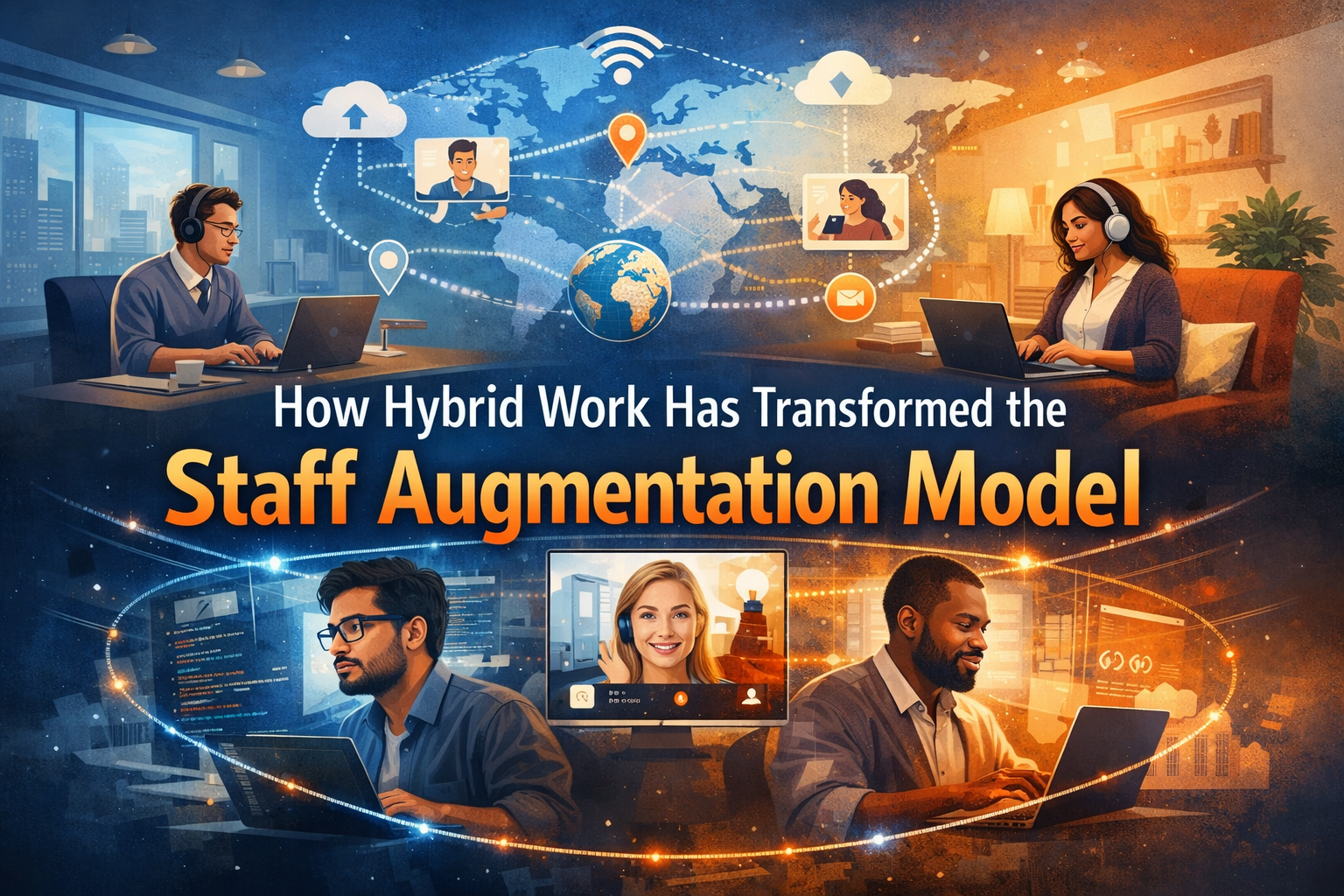
How Hybrid Work Has Transformed the Staff Augmentation Model
Hybrid work isn’t an experiment, the transitional way of things. It has become a long-term way of working, with teams spread across campuses and home offices but also co-working spaces and sometimes countries. This transition has not only altered the way companies think about managing employees but also how they hire, scale and access specialized talent. Staff augmentation has been one of the most transformational change. Organizations that once hired for specific support needs now see remote staffing as a strategic workforce solution, enabling the agility they need without compromising on the quality and speed of hiring talent.
Historically, staff augmentation has been seen as a temporary bandage you hire a couple of developers, testers or consultants for a specific project on which workloads suddenly become greater than available staff and then layoffs ensue when the job is done. Hybrid work has only broadened what staff augmentation can do now. Now it’s being utilize to construct long-term distribute teams, scale globally and develop more flexible talent ecosystems that can easily pivot to keep pace with changing market conditions.
Understanding Staff Augmentation Before Hybrid Work
Prior to the pivot toward hybrid work, staff augmentation tended to play out in a predictable manner. Firms brought in staff to perform on their premises, integrate closely with internal groups and adhere to stringent work-hour structures. Collaboration tend to be office-based, occurring in face-to-face meetings, discussions and approvals. Beyond that, hiring was often constrained by local geography- most companies wanted their thinkers to be able to sit in an office somewhere.
It also meant that staff augmentation was mostly transactional. Most businesses dealt with augmented workers as external resources working “in the vicinity” of the company, rather than part of the team. Although the staff augmentation model work in terms of productivity, it was not leverag to its fullest potential; rather it was often confine by fixed environments and the belief that you need to be in office to work.
Hybrid Work and the Rise of a Boundaryless Talent Pool
Hybrid work rewrote the rules by demonstrating that outcomes trump location. Once companies realized that high-flying teams can operate across multiple time zones and geographies, the access to talent increased dramatically. Rather than relying on local hiring markets, businesses now recruited professionals from pools nationwide and globally.
This is when the staff augmentation model truly gained strength. Now, companies could scale their workforces with right skilled professionals no matter where in the world they live.
This has created a major advantage for companies partnering with an IT staff augmentation company in India, because India offers a strong blend of technical expertise, cost efficiency, and experience with global delivery models.
That’s because with the normalization of hybrid work, Indian tech professionals should be more than “offshore support”; they’ll become members of core project teams, participating in planning, delivery and innovation alongside internal employees.
A Shift From “Extra Hands” to Strategic Team Extension
Among the most significant shifts wrought by hybrid work is how augmented staff are regard. The Augment professionals are being given an extende role rather than the position of a temporary worker. In a hybrid model, the boundary between internal and external is more porous; everyone contributes digitally on the same tools, workflows and communication channels.
The augmente team is now being establish as a permanent extension for such organizations. Rather than simply stacking up developers to staff the green or blue pod, companies can construct flexible pods and teams that can stick around for subsequent release cycles. This results in lower level of understanding and stronger accountability / velocity because augmented professionals aren’t constantly retraining on systems / docs.
Digital Collaboration Tools Have Rebuilt the Staffing Workflow
Hybrid work has only accelerated the use of digital collaboration tools like Jira, Slack, Microsoft Teams, Zoom, GitHub and GitLab and Notion. These tools have become so central to how businesses do work and they’ve likewise rewritten the equation of staff augmentation.
Right now, hiring, onboarding and daily operations are digital first. This has eliminated the friction and made it faster to have augmented professionals productive. Onboarding can be compress into a bite-sized hybrid format where documented workflows, video training modules and recorded knowledge transfers replace traditional in-person shadowing. This makes scaling a lot more transparent, which is especially useful for fast-growing startups and product companies.
Furthermore, performance management and team accountability has been made more visible using project dashboards, sprint boards, and task tracking. Professionals who are augmente can now show impact more directly and managers can judge output without having to count office hours logged.
Faster Scaling for Project-Based and Product-Based Organizations
Hybrid work the modern business is faster than ever. Product timelines are shorter, customer expectations are higher, and tech shifts occur quickly. In such a job market, employers can ill afford to take their time during hiring cycles. Conventional hiring can be slow, sometimes dragging on for weeks or even months — especially when you’re looking for a niche skill like DevOps automation, cloud security, data engineering or AI model deployment.
Staff augmentation complies perfectly with that scenario, because this model gives you instant access to available-to-work skills. Hybrid work makes it more powerful still, as it’s now untether from where you are resident, where you sit in an office or your geographic proximity. Businesses have the flexibility to ramp up during spikes and scale down post-milestones without breaking their delivery chain.
More Demand for Specialized Skills and Role-Based Hiring
Hybrid work also hasturd the need for specialist roles. As the enterprises start leaning towards a cloud-first approach and modern frameworks with automation, demand for niche skills has sky-rocketed. Staff Augmentation is used by companies today not just for development but also cybersecurity analysts, UI/UX researchers, QA automation engineers, data analysts, solution architects and even fractional CTO level guidance.
This has altered packaging of the staff augmentation model. Rather than just ask for ‘developers,’ companies now hire with role-level precision and outcome-based expectations.” Augmentation companies have made their answers by developing more robust vetted talent networks, while establishing “talent pools” of candidates who possess in demand skills.
Hybrid Work Has Encouraged Cross-Functional Augmentation
In the past augmentation wasn’t so integrate within the technical teams. But hybrid work has brought augmentation needs into marketing, operations, customer support and strategy. Today, many companies mix internal leaders with outsourced experts.
For instance, a business may keep brand strategy internal while partnering externally to outsource seo services and accelerate organic growth initiatives. This reflects a broader shift where augmentation is no longer just IT-focused it supports multiple business functions in an integrated way.
This cross-functional mentality can help companies move more quickly than they otherwise would, without dramatically ratcheting up full-time headcount. It also entails less risk: businesses can try out new strategies, enter markets, or start products without making a permanent commitment until the results are proven.
Security, Compliance, and Governance in a Hybrid Augmentation Model
Hybrid work broadens opportunity, but also poses risks especially when it comes to data security, compliance and IP protection. Remote working augmented pros and the need for governance There’s a need for structured governance within remote workers. It has led to innovations in staff augmentation contracts and processes.
And that is to look more like whether you represent someone with greater access, secure dev environments, NDA enforcement and preparedness for compliance– the visibility on dedicated infrastructure.” Outfacing many of these augmentation providers are more BAU (business as usual) type NLB businesses managing enterprise scale security processes, role based access, secure VPN onboarding, device compliance policies and documentation led governance.
Hybrid work has made staff augmentation mature. It’s no longer sufficient to merely provide the talent. Service providers must also exhibit trust, discipline and operational excellence.
Cultural Integration and Communication as Key Success Factors
Hybrid work is making communication and culture more intentional. When teams do not work in the same physical space, everything relies on clarity clear processes, clear goals and even clearer feedback loops. And that holds just as much for staff who are augmente.
Today’s staff augmentation demands more of a cultural fit than ever. Augmenting professionals should know how the company operates, product philosophy, quality standards and collaboration requirements. Companies that do well with hybrid augmentation treat communication as a system -regular sync-ups, sprint retrospectives, async updates and performance reviews help establish consistency across distributed teams.
This transition has also enhanced the quality of life for augmented workers. And they are more involve in being treat as part of the team and not disconnect, resulting in quality, retention and delivery outcomes in the long run.
Conclusion: Staff Augmentation Has Become a Hybrid Growth Strategy
Hybrid work has no longer only shifted the where of work it’s now shifting the how companies approach assembling teams. What is staff augmentation Staff Augmentation was born as an alternative to the traditional recruitment process but accelerated into a growth strategy that marks the flexibility characterizing companies today making it easier and faster for companies to scale, pivot and access global talent.
The best companies today are those that are adeptly balancing internal and external strengths. They leverage hybrid work to build high-performance teams without borders and turn to staff augmentation as a flexible, secure, and integrated model for workforce planning. The end product is a model built for the future, where companies can iterate and innovate without holding back because of outdate hiring standards.