AI Strategy Consulting: How to Build an AI Program That Delivers Real Business Results
Most businesses that have struggled with AI adoption share one thing in common: they started with technology instead of starting with a problem. They evaluated models, ran pilots, and built proofs of concept before anyone had clearly defined what success would look like or whether AI was actually the right tool for the job at hand.
AI strategy consulting exists to prevent that sequence from happening, and the difference in outcome for organizations that get it right versus those that do not is significant.
What AI Strategy Consulting Actually Does
AI strategy consulting is the work that happens before a single model is selected or a single line of code is written. It answers the questions that determine whether an AI investment will generate compounding returns or expensive lessons.
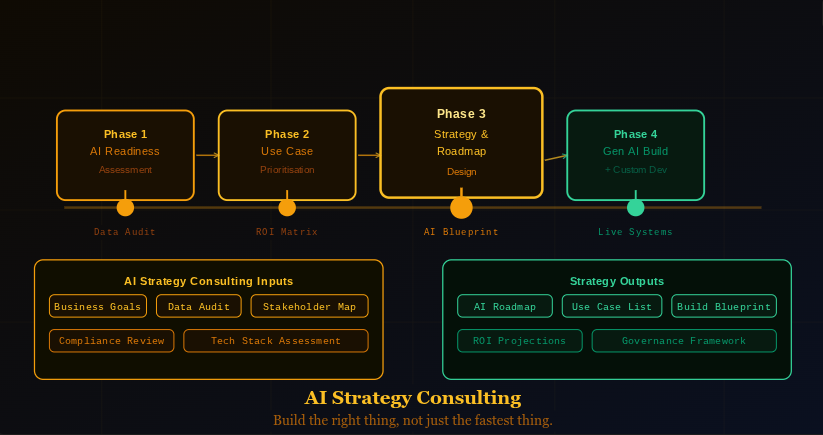
At BayOne, AI strategy consulting begins with a structured assessment of the business. What problems are generating the most cost, the most friction, or the most risk? Which of those problems involve the kind of repetitive, data-intensive, or judgment-heavy work that AI is genuinely suited to? What data exists to support an AI solution, and what is that data’s quality and accessibility? Who owns the outcomes, and what governance is needed to make this sustainable?
The output of that process is not a recommendation to use AI everywhere. It is a prioritized list of use cases with honest assessments of what each would require, what it would cost, and what it would return, mapped to a phased roadmap that the business can actually execute.
Why AI Strategy Consulting Prevents the Most Expensive Mistakes
The most common AI failure mode is not a model that does not work. It is a model that works technically but was built for the wrong problem. Or a model that was built for the right problem but deployed without the data infrastructure to support it in production. Or a model that produced good outputs in a controlled environment but was never validated against how users actually behave in the real system.
AI strategy consulting front-loads the thinking that prevents each of these outcomes. When strategy work is skipped, those failures are discovered after significant investment has been made, which makes them not only expensive to fix but politically difficult to recover from internally.
What a Strong AI Strategy Covers
A complete AI strategy consulting engagement addresses the following:
- Business problem mapping connecting high-value opportunities to AI-suitable characteristics
- Data audit covering availability, quality, governance, and the infrastructure needed to support production AI
- Use case prioritization using a framework that weighs ROI, feasibility, risk, and time to value
- Build vs. buy analysis determining where custom AI development produces better outcomes than existing tools
- Governance and compliance framework covering data handling, model explainability, and oversight requirements for the relevant industry
- Phased roadmap sequencing use cases in an order that builds capability incrementally and demonstrates value early
- Success metrics defined before development begins, connecting to business outcomes rather than model benchmarks
Custom AI Development Follows From Strategy, Not the Other Way Around
There is a version of custom AI development that starts by picking a model and working backward. It is fast to start and slow to finish, because the questions that should have been answered in strategy emerge as blockers during build.
BayOne’s approach runs the sequence correctly. AI strategy consulting establishes the why and the what. Custom AI development then delivers the how, with full confidence that the technical investment is aimed at a validated target. When the strategy is thorough, custom AI development moves faster, produces fewer surprises, and requires less rework because the scope was right to begin with.
Frequently Asked Questions
What does AI strategy consulting produce as a deliverable?
A completed AI strategy consulting engagement produces a prioritized use case list with feasibility and ROI assessments, a data readiness report, a governance framework, a phased implementation roadmap, and defined success metrics for each initiative. These deliverables give development teams a clear brief and give leadership a basis for evaluating progress against business outcomes rather than technical milestones alone.
How does AI strategy consulting connect to generative AI development services?
AI strategy consulting defines the problem, validates the data, and establishes success criteria before generative AI development services begin. This gives development teams a clear, validated scope rather than a set of assumptions to build against. The strategy deliverables become the acceptance criteria for development, which reduces scope drift and the rework that typically results from misaligned early decisions.
When is the right time to engage AI strategy consulting?
The right time is before any significant AI investment is made, including before model evaluations, proof-of-concept builds, or vendor selections. Organizations that engage AI strategy consulting after a pilot has already failed are using it correctly as a recovery tool, but the greater value comes from using it to prevent the failure in the first place. If AI is on the leadership agenda, strategy should happen in the next quarter.
Does AI strategy consulting require a large existing AI team internally?
No. AI strategy consulting is designed to work with organizations at any stage of AI maturity, including those with no dedicated AI function. The engagement produces a roadmap and governance framework that the organization can execute with a partner, not one that assumes an internal team is already equipped to run everything independently. Part of the strategy output is typically a clear definition of what capability needs to be built internally versus sourced.
How does AI strategy consulting differ from a technology assessment?
A technology assessment evaluates tools and platforms against defined requirements. AI strategy consulting works upstream of that, determining what the requirements should be in the first place by connecting business problems to AI capabilities and testing feasibility before committing to a technical direction. The output of AI strategy consulting often informs what a subsequent technology assessment should look for rather than replacing it.