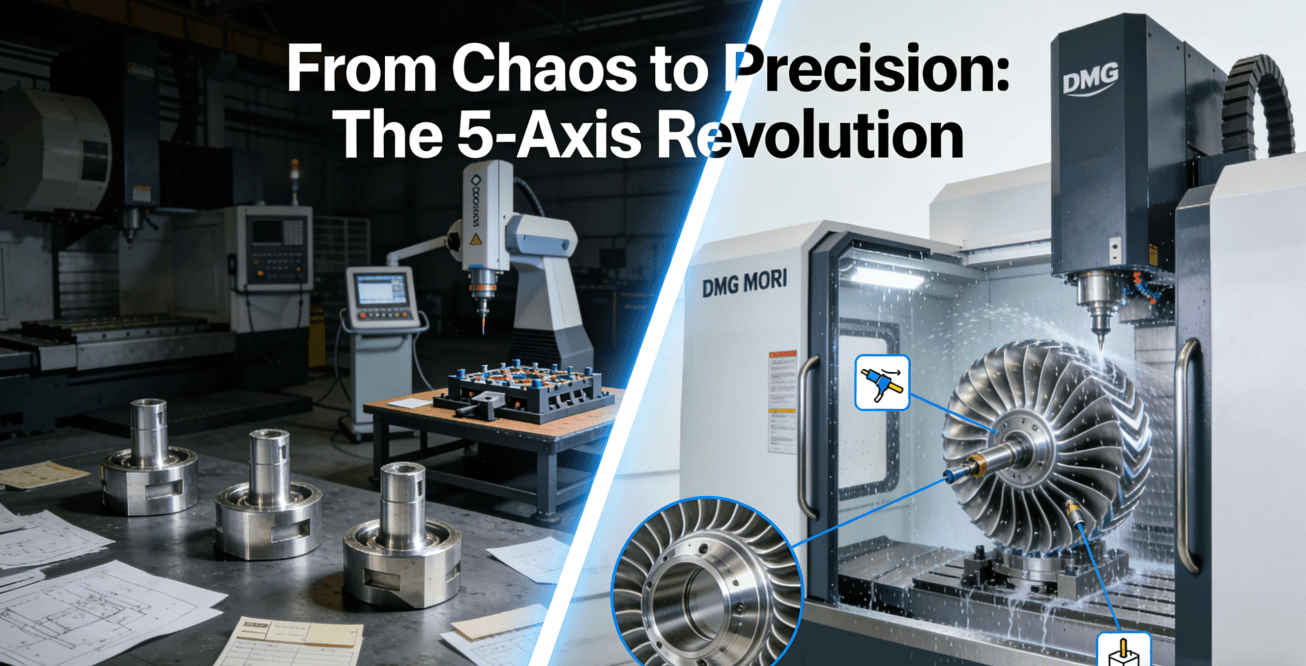
How Can 5 Axis CNC Services Cut Time by 40% and the Cost of Complex Parts by 30%
Introduction
In the field of high-end manufacturing, companies are often in a dilemma as parts with complex geometries, such as those used in the aerospace industry or medical implants, require traditional multi-step processing. This has resulted in increased lead times, problems in controlling cumulative errors, and increased comprehensive costs. This is because, in traditional production, decentralized production flows and multiple setups result in not only errors but also increased logistics, management, and time costs.Simple 3-axis CNC or outsourced “industrial solutions” involving multiple vendors can no longer meet the simultaneous pursuit of precision, speed, and cost-effectiveness.
This article will delve into how professional 5-axis CNC machining services leverage the core advantage of “complete machining in a single setup” to reconfiguration the production process, becoming an efficient, integrated industrial solution that fundamentally resolves the above dilemma. To understand this transformation, it is necessary to disassembly the technical logic and commercial value behind it.
Why is 5-Axis CNC Machining Service the Key to Today’s Complex Industrial Solutions?
Modern manufacturing is grappling with increasingly complex scenarios. For instance, multi-surfaced components, thin-walled structures, and single-piece designs are some of the new challenges. American Manufacturing Institute indicated the traditional methods that rely on several machines, a few outsourcing vendors, and many process steps are by nature split up and thus end up accumulating errors and requiring a lot of coordination.
The idea of an integrated industrial solution becomes very important in this context. It requires a great teamwork and the conversion of a digital model into an actual piece should be so seamless that it is hardly noticeable. 5 axis CNC Machining technology, with its five degrees of freedom, is the very physical basis for doing such complicated Precision Engineering on one and only machine tool. This technology makes it possible for the cutting tool to get to the workpiece from practically any angle. This facilitates machining of up to five sides and additionally, complex contoured surfaces can be machined in one clamping.
Nevertheless, the main point of turning advanced technology into consistent business value is through 5-axis CNC machining services, not just through owning the machines and related equipment. Moreover, an expert professional service provider can combine upgraded machinery, the know-how of the process, programming software, and quality systems into one complete solution. As per papers on manufacturing integration and advanced, these combined capabilities are necessary to build resilient and efficient supply chains. They can greatly reduce the internal technical barriers as well as the complexity of supply chain coordination. These integrated capabilities are essentially the solution to modern manufacturing challenges.
How Does the Workflow of a 5-Axis Machining Center overturn the Traditional Production Process?
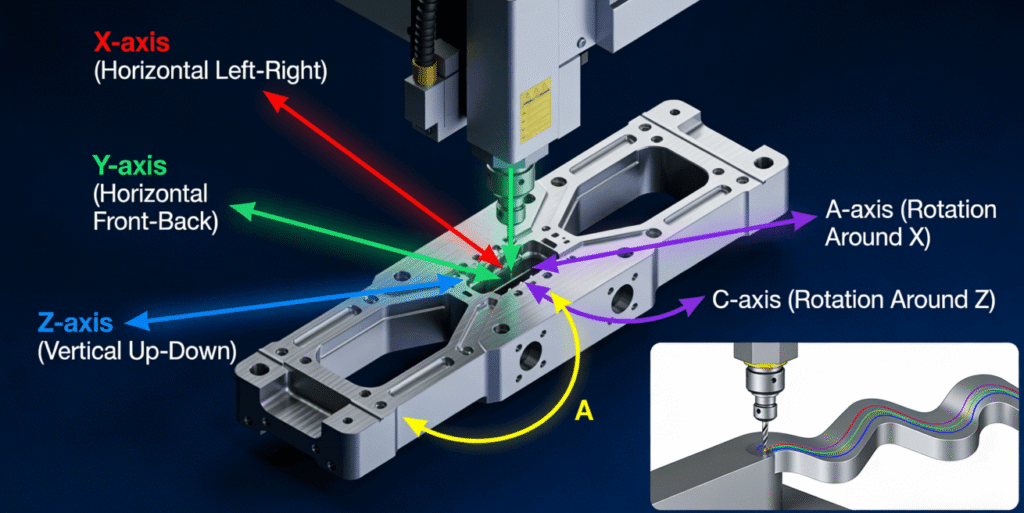
To understand the transformative power of 5-axis machining, one must first understand what are the 5 axis on a CNC machine. These typically are the three linear axes (X, Y, Z) and two rotational axes (e.g., A and C), allowing the workpiece or tool to tilt in space for multi-angle access, eliminating the need for multiple re-fixturing.
Moreover, the traditional Production Process is linear and disjointed which make it cause quality and lead-time issues. Traditional process flow of 3-axis machining can be re-phrased as: “Design -> Machine Side A on a 3-axis -> Remove Part -> Design/Build Special Fixture -> Re-fixture for Side B -> Remove Again -> Possible External Process -> Final Inspection/Assembly.” Each arrow is a potential point for quality, logistic and management issues. Whereas doing the work on 5 axis machining center is totally different, and you get actually quite a few tasks at once: Typical workflow on a 5 axis machining center can be summed up as: “Design (with DFM) -> Single Setup -> Complete Machining -> Final Inspection.” Production on a professional 5-axis machining center starts with intelligent CAM programming for optimizing the tool paths. Besides machining, on-machine probing makes it possible to automatically align the workpiece and compensate its dimensions. This machine-controlled, uninterrupted process drastically reduces human interfacing and hand-off points.
What are the Advantages of True 5-Axis Simultaneous Machining Compared to 3+2 Axis Indexed Machining?
Technical Essence: Positioning vs. Continuous Contouring
A crucial distinction must be made between “3+2 axis positional machining” and “CNC 5 axis simultaneous machining.” The 3+2 mode essentially locks the rotary axes at an angle to perform 3-axis milling, then repositions for the next area—it is still sequential machining. True 5-axis simultaneous machining involves the coordinated, continuous movement of all five axes under computer control, maintaining the optimal tool orientation relative to complex surfaces throughout the cut.
The Core Advantages of 5-Axis Simultaneous Machining
5-axis simultaneous machining is indispensable for parts with complex, continuous surfaces like impellers, propellers, and turbine blades. It enables:
- High-Quality Contours:
Superior surface finishes by continuous tool axis vector control, avoiding “cusp” marks. - Extended Tool Life:
Machining with the side of the tool or maintaining an optimal contact point improves cutting efficiency and reduces wear.
The Resource Barrier and the Value of Professional Services
British Technology Manufacturing Association reported Building in-house 5-axis simultaneous capability presents a high barrier. The initial capital costs involved in the purchase of the equipment (the price of the 5 axis CNC machine) are high. Even rarer are the soft Resources: the expertise in CAM programming and post-processing with multiple axis machines, the skilled human resources needed to operate the machinery and the technicians needed to run the processes, the high software costs, and the maintenance costs. This just goes to emphasize the need to find the right business partner. If one wants to get deeper insights into the technical details and the considerations involved in the selection of CNC 5 axis machining, one can refer to this comprehensive guide.
Furthermore, white papers from authoritative bodies state that with 5 axis simultaneous machining, the efficiency and accuracy can be improve by as much as 70%.
How to Rationally Evaluate the ROI of 5-Axis CNC Machine Price and Services?
Confronted with complex part needs, companies are first met with the staggering 5 axis CNC machine price. This price encompasses not just the machine base but also high-end CNC systems, large tool magazines, and initial installation and calibration, representing an investment of hundreds of thousands to millions of dollars.
Therefore, the decision should shift from “purchase price” to “Total Cost of Ownership.” This includes equipment depreciation, floor space and energy, daily maintenance, the cost of specialized programmers and operators, software updates, and the risk of obsolescence. For firms not continuously producing 5-axis parts at high volumes, these fixed costs are heavily amortize per part.
In contrast, procuring professional 5 axis CNC machining services converts high fixed costs into a clear variable cost model. Companies pay only for the actual machine time and material consumed, not the massive capital outlay and resource management overhead. This model allows flexible access to top-tier manufacturing Resources, freeing capital for core R&D.
While evaluating the service provider, the parameters should not just stop at the equipment list they have. The presence of international certification like ISO 9001, IATF 16949 (automotive), AS9100D (Aerospace), etc., is the key to evaluating the ability of the service provider in offering a stable Precision Engineering service with a traceable Production Process, thereby making the service provider capable of offering an ‘industrial-grade solution’ as opposed to just a ‘one-off job.’
What is the Collaborative Process for Integrating External 5-Axis Machining Service Resources?
A Seamless, End-to-End Collaborative Process
Ideal partnership with a 5-axis CNC machining services provider begins with integrated engineering support. This seamless process minimizes disruption to a company’s internal Production Process, transforming an external service into a natural extension of its own Resources.
- Integrated Workflow from Design to Delivery
Collaboration commences with Design for Manufacturability (DFM) analysis in the design phase, optimizing the parts for cost and manufacturability, and continues through instant online quoting, order processing, and certified production, as well as rigorous inspection and reliable delivery.
- Strategic Value of Early-Stage Engagement
It’s essential that the provider’s engineers actively engage in the project at an early stage, advising on tool access, fixturing, and material characteristics to avoid expensive redesigns or failure, ensuring the success of complex Precision Engineering projects from the very beginning.
Achieving Strategic Flexibility and Focus
This model delivers strategic business advantages. It allows companies to rapidly launch complex projects via simplified portals, converting high fixed costs into predictable variable expenses. This provides on-demand access to advanced capabilities and flexible capacity, enabling firms to focus internal Resources on core innovation and market growth.
Conclusion
Faced with the manufacturing challenges of complex parts, viewing 5-axis CNC machining as an integrated external industrial solution, rather than just an internal capital investment, has become a strategic choice for leading firms. It optimizes the entire Production Process from design to finished part, transforming Top-tier precision engineering Resources into predictable time and cost advantages, enabling greater market agility. It is time to re-evaluate your next complex component project and consider engaging an end-to-end 5-axis CNC machining service partner capable of providing everything from DFM analysis to certified production, turning the efficiency gains discussed into tangible competitive advantage.
Author Biography
This article’s author is an independent analyst in manufacturing digital transformation, focusing on advanced manufacturing technologies and supply chain optimization strategies, providing insights for numerous industrial media outlets. The article references the technical expertise and service framework of CNC Protolabs, a provider of integrated precision manufacturing solutions.
FAQs
Are 5-axis CNC machining services suitable for low-volume prototyping?
A: Yes, very suitable. The biggest benefit of 5-axis machining is that it can be used to quickly produce even the most complex parts in single or low volumes simply by programming the machines. No complicated fixtures are needed, which means the prototype verification phase can be accomplished in record time.
Is 5-axis machining always more expensive than 3-axis?
A: The hourly rate could be a bit higher. But in case of complex parts, a single setup to complete the job saves the overall machining time, fixture cost, and error rework, so the total cost is most likely less and the project is more economical.
How can I tell if my part requires 5-axis machining?
A: If your component has several surfaces that need machining, deep cavities, inclined surfaces, or continuous.n complex contours and you would need to re-fix the part several times on a 3-axis machine, 5-axis machining is generally the better option.
When outsourcing 5-axis machining, how is my design IP protected?
A: You should pick a service provider who can show you strict Non-Disclosure Agreements (NDA) and has trustworthy information security management. Those who are certified to standards like ISO 27001 offer a higher level of confidence with regard to data security.
What is the usual timeframe for the whole process starting from quotation and ending over receiving parts?
A: The timeline largely relies on the complexity of the part. Typically, a quote for a machining operation on an aluminum part of average complexity can be given by a specialist service provider within one to three days. Machining and delivery can be accomplish within one to two weeks, and there are options for faster processing.